Monday, November 12, 2012

The Gibbons v. Ogden Case (1824)

  • Explain the role of the supreme Court in interpreting the Constitution, the concept of judicial review, and how this case modified it. 
The Supreme Court of the United States has the ultimate responsibility for settling disputes and interpreting the meaning of laws. It also determines what national policy will be when it applies law to specific disputes. 

The Supreme Court has the final say on all legal matters that come to it. Additionally, it is the highest court in our system and there is no appeal from its decisions unless future courts reverse past court decisions. The Gibbons v. Ogden (1824) vastly expanded the powers of Congress through a single clause in the Constitution: the Commerce Clause of Article I, Section 8. Without the presence of this case, those powers would have been never been explored upon.  After the Ogden v.Gibbons case, the Supreme Court ruled that under that clause Congress had powers to regulate any aspect of commerce that crossed state lines, including modes of transportation, and that such regulation preempted conflicting regulation by the states. Since Gibbons, the Commerce Clause has provided the basis for sweeping congressional power over a multitude of national issues.

 The state of New York gave Aaron Ogden an exclusive license to operate steamboat ferries between New Jersey and New York City on the Hudson River. Thomas Gibbons, another steamboat operator, ran two ferries along the same route. Ogden, then decided to go  


In conclusion, the Court interpreted the Commerce Clause of the U.S. Constitution for the first time. "Congress shall have power to regulate commerce ... among the several States," said the commerce clause.  


Monday, October 15, 2012

The Man Who Has Done It All, John Langdon


This is a photo of John Langdon.


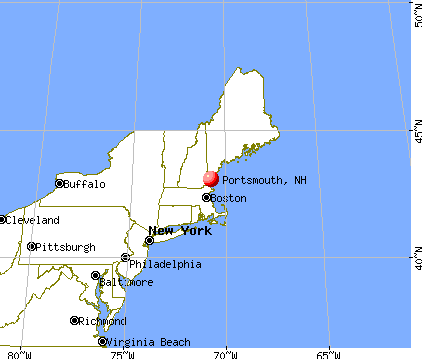
John Langdon. Who is John Langdon? To the lower class, he was not people's most favorite person. But to the upper class however, this was just simply another one of them. Another one, that would eventually end up representing them for upcoming Constitutional Convention or whenever it was the time to maker important decisions. He was born on June 26, 1741 in Portsmouth New  Hampshire. He was born during the period after The Great Awakening was slowly coming to an end. [We all can take back a journey to memory lane, where people were slowly being allowed to publicly express their religion, but it's better if we just keep it that way.]

Portsmouth, New Hampshire:Location of Birth of John Langdon
While growing up, he  attended the local grammar school; served an apprenticeship as a clerk. Later on, he  went to sea, and engaged in mercantile pursuits;which, eventually led him to becoming another "upper class" rich white man. 

John Langdon, was a prominent supporter of the revolutionary movement and active in the Revolutionary War contributing towards being a member of the  Member of the Continental Congress in 1775 and 1776. These were extremely crucial and important time periods within the nation because the Declaration of Independence was being signed by influential individuals such as Thomas Jefferson and John Adams. 

Langdon unfortunately resigned in June 1776 to become an agent for Continental prizes and superintended the construction of several ships of war.
 He was greatly remembered at the Continental Congress as he had served several terms as speaker of the State house of representatives, and during the session of 1777 staked his fortune to equip an expedition against the British. 

In a way, I guess you can say that John Langdon pretty much did it all throughout his life. He did anything anyone win today's society would dream of doing. After leaving the Continental Congress, he participated in the Battle of Bennington and commanded a company at Saratoga. 

Here a few key points to keep in mind about John Langdon, you're welcome. 


  • Rhode Island member of the State Senate 1784
  •  President of New Hampshire 1785-1788
  •  Once again a Member of the Continental Congress in 1787
  • delegate to the Federal Constitutional Convention in 1787 
  •  elected to the United States Senate and served from March 4, 1789, to March 3, 1801 
  • also served as President pro tempore of the Senate during the Second Congress
  •  declined to accept the portfolio of Secretary of the Navy in the Cabinet of President Thomas Jefferson in 1801
  •  Member, New Hampshire legislature from 1801-1805, the last two terms as speaker
  •  Governor of New Hampshire 1805-1811, with the exception of 1809
Woah. At some point, that list had to end. Politicians were going around in circles switching role or reprising their roles as powerful men in the Continental Congress. This man was so successful that he even was nominated for Vice President candidate in 1812. Unfortunately, he declined the nomination. 

John Langdon died in the same location where he was born. Coincidentally? Maybe.  He died in Portsmouth, N.H., September 18, 1819 and is 6 feet below the ground at the Langdon tomb in the North Cemetery.

Wednesday, October 3, 2012

The Great Awakening:Reflection

This is the final "reflection" blog for this section. The First Great Awakening, occurring around 1730s  and  1740s, had a profound impact on the course of the United States. Although not widely spoken of in modern times, the Great Awakening was a movement rooted in spiritual growth which brought a religious  identity to Colonial America. Christians, Quakers, and Puritans wanted to express themselves. The Declaration of Independence inculcated for the "social compact."

 Influential preachers like Jonathan Edwards who wrote the powerful speech "Sinners in the Hands of an Angry God," had a tremendous impact throughout the Great Awakening. It encouraged people to express their beliefs, which in England at the time was mostly Christianity. 

Question: Compare the ways in which religion shaped the development of colonial society (to 1740) in two of the following regions:New England,Chesapeake,Middle Atlantic

Thesis:During the 1730s and the 1740s, the mother country went through a series of revolutions that fought for religious freedom and therefore crossed social,political, and economic changes. The Great Awakening was major impact to the New England colonies and shaped their society and caused, many colonist to creativity. 


Through the Awakening, the Colonists realized that religious power resided in their own hands, rather than in the hands of the Church of England, or any other religious authority.This goes back to Johnathan Edwards and another preacher George Whitefield.  After a generation or two passed with this kind of mindset, the Colonists came to realize that political power did not reside in the hands of the English monarch, but in their own will for self-governance (consider the wording of the Declaration of Independence). 

By 1775, even though the Colonists did not all share the same theological beliefs; they did share a common vision of freedom from British control.

Tuesday, October 2, 2012

The Atlantic Slave Trade:Reflection

The Atlantic Salve Trade, also known as Triangular Trade, is the import and export route that is literally in the shape of a triangle. The Atlantic slave trade took place between Africa and the West Indies. This route bough together Native American, Indians, and the Africans. Merchants were typically the ones that made up the Atlantic Slave Trade route. The thing that made Africa a powerful kingdom  so powerful was that they had one thing--Gold, and everyone wanted it. 

Slaves were shipped off  in the form of what was called, "loose/tight packing." Basically, people  slaves, were placed upon a ship, like a bunch of "sardines" stacked on top of each other, and it all depended to see who would survive. 

Question: How did economic,geographical, and social factors encourage the growth of slavery as an important part of the economy between 1607 and 1775 in the Southern colonies. [Southern colonies: Virginia, North/South Carolina's, and Georgia.
Thesis: Between 1607 and 1775, slavery in the Southern colonies grew up resulting from was the 
"necessity" of profit. Blacks were humanely treated, leading to the American relying on profitable plantation systems that were relying on slavery;thus, creating a social system on race. 

The Religious Society of Friends AKA The Quakers, whom William Willowburforce helped propose the Slave Trade Act of 1794. The act didn't allow ships to be used for slave trade. 

In 1807, Congress would outlaw implementation of slaves. On January 1st,1808 the aw was officially implemented. This became to the contribution to the Treaty of Paris. France and England would outlaw slavery in 1814.

Reflecting on The Glorious Revolution

The colonists and the British obviously did not know that a Glorious Revolution was going to blow up right before their eyes. Within this presentation, they focused on the events that occurred during the Revolution. The Revolution, also called the Revolution of 1688, or the Bloodless Revolution,  took place between the 1600s and mid 1700s, took place in England. Bottom line: It was a competition to see which country had greater colonial power. 

Question: Analyze the way in which British Imperial policies between 1763 and 1776 intensified colonials resistance to British rule and their commitment to republican vales.


We learned about James II was thrown out of power because he tried to impose the roman Catholic. This created an accession of his daughter Mary II and her husband William II Prince, but on the contrary to James II, they were Protestant. One of the things that they legalized in England was the toleration Act  of 1763.


King James's policies of religious tolerance after 1685 met with increasing opposition by members of leading political circles, who were troubled by the king's Catholicism and his close ties with France. The crisis facing the king came to a head in 1688, with the birth of the King's son, James Francis Stuart, on June 10th. Some of the most influential leaders of the Tories united members of the opposition Whigs and set out to resolve the crisis by inviting William of Orange to England.

The Revolution permanently ended Catholicism in England. For British Catholics its effects were disastrous both socially and politically. 
 It has been argued that James's overthrow began modern English Parliamentary system. The Bill of Rights of 1689 has become one of the most important documents in the political hisotry of Britain and never since has the monarch held absolute power

Tuesday, September 25, 2012

My Reflection on The Enlightenment Presentation

     Day One of presentations in AP US History, and I must admit, I got a lot of good information with the first presentation by Fernanda,Astrid, and Stephany. Their presentation was primarily about the Enlightenment period. Before diving into the presentation, they question states, "Using the provided documents,explain how the Enlightenment period influenced the ideas of the American Revolution." Crafting the thesis is becoming a work that keeps going for all of us, and although it is frustrating, it takes time, and eventually we will get there.

Their thesis: "The Enlightenment influenced the American Revolution in three different forms;ideologies,the Declaration of Independence and the Constitution." This is the original thesis, not the thesis that was re-written after we edited as a class. 

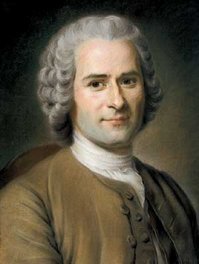
Throughout the presentation, we got introduced to the influential individuals during the Enlightenment period. Thomas Hobbes, John Locke, and Jean Jacques Rousseau, were heavily involved during that time period, and still have impacted our society today.
Jean Jacques Rousseau, "The Social Contract"

Jean Jacques Rousseau's political philosophy influenced the French Revolution as well as the overall development of modern political, sociological and educational thought. Additionally, Rousseau introduced "The Social Contract," which elaborates the idea of the idyllic freedom. Basically, in order for someone to get their rights, they would have to sign a form known as "The Social Contract," which gave people their rights. This sounds too good to be true right? Of course, signing "the Social Contract" has its perk-- isolate yourself from society. So much for freedom, after all. I was shocked by what I had learned because I realized that "FREEDOM" was not freedom so much after all. 


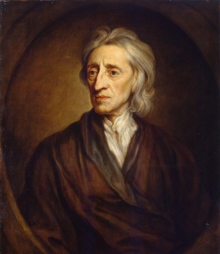
John Locke
John Locke introduced the idea of Natural Rights which he strongly believed in and were Life,Liberty, and the Property. When philosophers were getting together to write the Declaration of Independence, they incorporated Locke's similar beliefs into it. 
"We hold these truths to be self-evident, that all men are created equal, that they are endowed by their Creator with certain unalienable Rights, that among these are Life, Liberty and the pursuit of Happiness." However, instead of keeping the property part, they changed it to the Pursuit of Happiness because maybe "property" was not intended for everyone-- for "WE THE PEOPLE."

Those are the characters we introduced to within the presentation. I tremendously got the "The Social Contract" information cleared up in my head because I was always unsure about what it meant. During our Sophomore year, we had went into the Enlightenment and the complete list of the most influential philosophers but I had forgotten most of it, and this was a great way to get my memory refreshed. I know that for the AP exam, the graders aren't going to be as nice when it comes to the scoring,but this was a great way to learn from mistakes,and to not make them happen once again.


Thursday, September 13, 2012

The First Governor of The Massachusetts Bay Colony


I am English Puritan New World leader  John Winthrop, and was born January 12, 1588 – March 26, 1649) . Throughout my life, I was well known for accomplishing the grueling task of officially joining the Massachusetts Bay Colony in 1629 and was also elected the first governor on April 8, 1630.


When I became governor, I delivered, in an angry tone, my sermon "A city Upon A Hill." It states that the Americas are setting the stage religious wise for others to follow and learn from. God has destined everyone to suffer from the unprecedented events and happenings from Hell.

 Additionally, I was know to be a religious Christian and believed that the Anglican Church had to be cleansed of Catholic ritual.English Puritans needed a shelter away from England where they could remain safe during the time of God’s wrath, and I was going to help them find a relief towards the Catholic ritual.I declared that the Puritan colonists emigrating to the New World were part of a special pact with God to create a holy community. They were going to be influential for generations
 to come.

During my term for being the Governor, I was one of the least radical of the Puritans. People liked me because  the number of executions were being maintained at a minimum and was working towards preventing the implementation of more conservative practices such as veiling women.


In total I married 4 times, and had a total of 13 children.

·         Mary Forth, was my first wife, and we married on April 16, 1605 at Great Stambridge, Essex, England. She bore him six children and died in June 1615. The youngest son became the Governor of Connecticut in a later stage of life.
·         Thomasine Clopton, was my second wife. We got married  on December 6, 1615, at Groton, Suffolk, England. Unfortunately, the love of my life at the time died on December 8, 1616. We did not have any children.
·         I married  Margaret Tyndal, my third wife on April 29,1968. I had the most children with Margaret Tyndall , as together we engendered  six children in England before the family emigrated to New England .Many people don’t know this but, one of my daughters died on the Lyon voyage. Two children were born to them in New England in 1630. Margaret died on June 14, 1647.
·         Finally, I married Martha Rainsborough, who was a widow of Thomas Coytmore. In this marriage however, we did not have more than one son and that was in 1648.


I  signed the Cambridge Agreement March 4, 1629,to embark on the next voyage and find a new Puritan colony in New England. The colony’s land was taken from Native Americans with Winthrop’s excuse that the natives hadn’t “subdued” the land and thus had no “civil right” to it.


I was the governor of the Massachusetts Bay Colony in 1629 and served for a total of 19 years years. The Constitution operated differently to the way it does today, because today the presidents are allowed to serve for only two terms, a total of 8 years.