Monday, February 25, 2013

The Panama Canal

The Following is a powerpoint presentation in regard to the Panama canal.  A few facts about the Panama Canal.


  • 200 million tons of products cross every year


  • Connects the Atlantic and Pacific Ocean


  • Ships the size of skyscrapers cross through the Panama Canal


  • Helps move ships an entire country cross and saves ships the drag of making the trip throughout the entire country


  • In the midst of the Panama Canal is Gatun Lake and Gillard Cut


  • Up to 1,0000 ships crossed in the years 1914


  • The so-called, "Panamax" is the  largest ship the Panama Canal can handle.


  • The triple locks. each of the triple locks stretches 300 meters enough for the Eiffel tower to lie back and high enough to pack 3,000 buses!


Friday, February 8, 2013

When Muckracker meets Journalist. Meet, Samuel Hopkins Adams


John Samuel Hopkins. He is well known for his extraordinary line of work as an investigative Journalist.  To gain that knowledge, he attended Hamilton College. He was just one of the many so called, "muckraker" journalists, that would many of the times go undercover, all in the work to expose a  lie being hidden by the government. 

From 1891 to 1929, he was a reporter for the New York Sun and then continued his Journalism career by joining McClure's Magazine. It was within this magazine where he gained a reputation as a muckraker for his articles on the conditions of public health in the United States.
In a series of eleven articles he wrote for Collier's Weekly in 1905, "The Great American Fraud", Adams exposed many of the false claims made about patent medicines, pointing out that in some cases these medicines were damaging the health of the people using them. The series had a huge impact and led to the passage of the 1906 Pure Food and Drug Act.
Adams series of articles on this subject, compelled the Supreme Court in 1911, to rule that the prohibition of falsifications referred only to the ingredients of the medicine. This meant that companies were again free to make false claims about their products. Adams returned to the attack and another series of articles in Collier's Weekly, Adams exposed the misleading advertising that companies were using to sell their products.


In addition to his line of work for well-known media outlets, Adams also wrote short-stories and novels. They were the following:
  •  The Health Master (1913)
  • The Clarion (1914)
  • The Unspeakable Perk (1916)
  • Square and the People in It (1917)
  • Success (1921) 
  • Siege (1924)
  • The Gorgeous Hussy (1934) 
  •  Maiden Effort (1937). 
  • biography of Warren Harding entitled, Incredible Era (1939). 
  • One short story, Night Bus, was turned into a film, It Happened One Night
  •  Canal Town (1944)
  •  a biography of Alexander Woollcott (1945)
  • The Pony Express (1950)
  • The Santa Fe Trail (1952) 
  • The Erie Canal (1953) 
  •  Grandfather Stories (1955)


Samuel Hopkins Adams long Journalism career came to an end when he died at Beaufort, South Carolina, on 15th November, 1958. The cause of death is stated.

Saturday, January 19, 2013

The "Poster-Girl" for Non-Violence Resistance, Rosa Parks!

Usually we'd have the usual phrase,the "poster-boy" but in this it's all about the "poster-girl." This is not your average woman. We're talking about an influential and important that helped refine freedom: Rosa Parks. She worked as the secretary for the NAACP (National Association for the Advancement of Colored People) for a many years. 

Rosa Parks was born  in Tuskegee, Alabama, on February 4, 1913, to Leona and James McCauley, a teacher and a carpenter, respectively. She was small as a child, suffering from poor health with chronic tonsillitis. When her parents separated, she moved with her mother to Pine Level, just outside the capital of Montgomery
. She grew up on a farm with her maternal grandparents, mother, and younger brother Sylvester. 

She organized and collaborated with civil rights leaders, including president of the local chapter of the NAACP Edgar Nixon; and a new minister in town who gained national prominence in the civil rights movement. She had recently attended the Highlander Folk School, a Tennessee center for training activists for workers' rights and racial equality. She acted as a private citizen "tired of giving in". Although widely honored in later years, she also suffered for her act; she was fired from her job as a seamstress in a local department store.


Rosa Parks was perceived as hard-working ans quiet. But on December 1, 1955, in Montgomery, Alabama, Parks refused to obey bus driver, NOT ONCE, BUT THREE TIMES!  James F. Blake's order that she give up her seat in the colored section to a white passenger, after the white section was filled. Parks was not the first person to resist bus segregation. But she was certainly the last one to remain seated when everyone the other two people gave in to their resistance. Others had taken similar steps in the twentieth century, including Irene Morgan in 1946, Sarah Louise Keys  in 1955, and Claudette Colvin nine months before Parks. NAACP organizers believed that Parks was the best candidate for seeing through a court challenge after her arrest for civil disobedience. But overall, she exemplifies that it is possible to show resistance in a non-violent way, without the use of weapons or any other methods. 

Parks received national recognition, including the NAACP's 1979 Spingarn Medal, the 
Presidential Medal of Freedom, the Congressional Gold Medal , and a posthumous statue in the United States Capitol's National Statuary Hall. Upon her death in 2005, she was the first woman and second non-U.S. government official to lie in honor at the Capitol Rotunda.


APPARTS on Rosa Parks

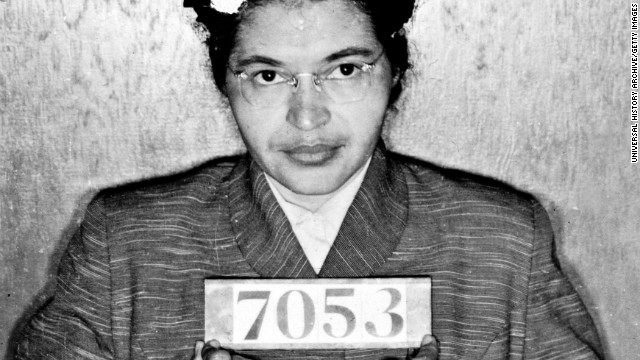
Arrest Report on Rosa Parks
Author: City Of Montgomery 

Place/Time: December 1,1955 in Montgomery Alabama

Prior Knowledge: She worked as the secretary for the NAACP (National Association for the Advancement of Colored People) for a many years. 

Audience: Everyone

Reason: On December 1, 1955, Rosa Parks was arrested for refusing to give up her seat to a white passenger on a city bus in Montgomery, Alabama.

Main Idea: Rosa Parks is a great example of non-violent resistance.

Significance: This single act of non-violent resistance sparked the Montgomery bus boycott, an eleven-month struggle to desegregate the city buses. Under the leadership of Martin Luther King Jr., the boycott resulted in a U.S. Supreme Court ruling that public bus segregation is unconstitutional and catapulted both King and Parks into national spotlight.


Monday, January 14, 2013

The Trials of Reconstruction

Ever since the Jeffersonian Era, the ideology of "All men are created equal" has been widely advocated by Thomas Jefferson himself, as well as many other philosophers. History repeats itself.  Now, we face ourselves with the burning question: Since the period of Reconstruction have people of color gained equal rights? Even today, people of color are still fighting for equality although many can argue that equality has been granted and guaranteed to all. The ideology of "equality" is still today, simply an illusion for Americans, and in many countries is far from being an accomplished task.


The Freedom's Bureau exemplifies one of the greatest injustices ever aimed at African Americans. In June 1865, some 40,000 freed people had been settled on "Sherman Land" in South Carolina and Georgia, in accordance with Special Field Order 15.  All land in federal had to be returned to its original owners. This meant, that African Americans who were stated to been "free" were no longer free. They were taken the opportunity to own land. Although the African Americans were told that were officially "free", many may ask themselves what was the point of having freedom if they weren't allowed impacting decisions. when THEY were still owned, they roof and shelter covered, but it all came with a couple of perks.. Those perks meant working long hours regardless of the weather conditions, and some may even require working in hazardous conditions.

Today, there is the constant reminder that there is an existent barrier between gender and color. In a recent article on the Huffington Post, it showed how people of color and women got paid 58-68 cents as compared to men and people that are not of color. In 2002 and 2010, there were acts that were proposed in order to change all of this. Unfortunately, out of both of the times that they were proposed, not once did it pass. Later on 2013,  once again, there will be an attempt to change the barrier of the paid amount towards people of color.  That barrier between people of color clearly still exists well after the Trials of Reconstruction.


Wednesday, November 21, 2012

The Path To Freedom


  • Is human nature fundamentally good or bad
  • Can legislation change human behavior?
  • Should we seek gradual or immediate changes to society?
  • Can society be improved by active involvement or by withdrawal?
  • What makes the good society?

About: Harriet Ross was born into slavery in 1819 or 1820, in Dorchester County, Maryland. Given the names of her two parents, both held in slavery, she was of purely African ancestry. She was raised under harsh conditions, and subjected to whippings even as a small child. At the age of 12 she was seriously injured by a blow to the head, inflicted by a white overseer for refusing to assist in tying up a man who had attempted escape. At the age of 25, she married John Tubman, a free African American. Five years later, fearing she would be sold South, she made her escape.Tubman was given a piece of paper by a white neighbor with two names, and told how to find the first house on her path to freedom. At the first house she was put into a wagon, covered with a sack, and driven to her next destination.  In 1851 she began relocating members of her family to St. Catharine's, (Ontario) Canada West. North Street in St. Catharine's remained her base of operations until 1857. While there she worked at various activities to save to finance her activities as a Conductor on the UGRR, and attended the Salem Chapel BME Church on Geneva Street.

Human Nature can be good, but also bad when it is influence upon the law. When the law is commanding them to follow certain rules instead of what is right, then they are conveyed to not follow what they think is right. This however leads to the fact that legislation can lead to a change in human behavior. Until human behavior changes, people will still be TOO afraid, TOO oppressed, to speak out about abolishing slavery, and letting women have their rights. We need to seek gradual changes immediately because right now, the time period in which we are will be looked upon by thousands in future.  An idyllic or good society is one that is actually for the people. Right now, we are constantly being told that society is for the people but it is only including a certain group of people. ":For the People" is excluding women and slaves. Is that a "For the People" government?

Friday, November 16, 2012

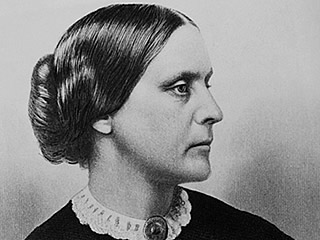
"Failure is Possible," said Susan B. Anthony


  • Is human nature fundamentally good or bad
  • Can legislation change human behavior?
  • Should we seek gradual or immediate changes to society?
  • Can society be improved by active involvement or by withdrawal?
  • What makes the good society?People who represent the Feminism and Abolitionist movements. Legislation can change the human behavior because the laws that they decide will take a tremendous effect on the individual. They will also determine her woman's right swill be placed upon in the future.The good and evil that you see don't even exist in reality, at least not outside of the mind that believes in them. They are only judgments passed by the individual from their own unique perspective. What one person sees as bad or evil may seem to be the only logical thing to do from some other perspective. The ideas of both good and evil are point of view specific. This is why people like bush and bin laden are either loved or hated. Bush was seen as good by people who shared his fear based thought system. Those who have a compassionate concern for all of mankind often saw him as evil.We should seek changes to society immediately because in this time period specifically, we are influencing the nation that will be governed for years to come. Our main priority is to set the standard of equality for all, and actually meaning it. By involvement, society is the only way it will ameliorate because if we don't get involved, our voices won't be heard. Women won't get their voting and educational rights that they deserve.  Susan B. Anthony dedicated her life to "the cause," the woman suffrage movement. The accomplishments of Susan B. Anthony paved the way for the passage of the Nineteenth Amendment in 1920 (14 years after her death) which gave women the right to vote. The influential Susan B. Anthony was born on February 15, 1820 in Adams, Massachusetts.
    In the 1800s most girls did not receive a formal education. But, Susan B. Anthony's father, Daniel, as a 6th generation Quaker, believed in equal treatment for boys and girls. Consequently, Susan and her three sisters had the same opportunity for advanced education as her two brothers. Susan was fortunate enough to be given the chance to attend a private Quaker boarding school in Philadelphia. 

    Accomplishments:
    • Founded the National Woman's Suffrage Association in 1869 with life-long friend Elizabeth Cady Stanton. Together they worked for women's suffrage for over 50 years.
    • Published "The Revolution" from 1868-1870, a weekly paper about the woman suffrage movement whose motto read, "Men their rights and nothing more, women their rights and nothing less.
    • First person arrested, put on trial and fined for voting on November 5, 1872. Unable to speak in her defense she refuse to pay "a dollar of your unjust penalty."
    • Wrote the Susan B. Anthony Amendment in 1878 which later became the 19th Amendment giving women the right to vote.
    • Helped found the National American Woman's Suffrage Association in 1890 which focused on a national amendment to secure women the vote. She served as president until 1900.
    • Compiled and published "The History of Woman Suffrage (4 vols. 1881-1902) with Elizabeth Cady Stanton and Matilda Joslyn Gage.
    • Founded the International Council of Women (1888) and the International Woman Suffrage Council (1904) which brought international attention to suffrage.
    • An organization genius -- her canvassing plan is still used today by grass root and political organizations.
    • Gave 75-100 speeches a year for 45 years, traveling throughout the the United States by stage coach, wagon, carriage and train.
    • Led the only non-violent revolution in our country's history -- the 72 year struggle to win women the right to vote.
    Anthony died in Rochester New York of pneumonia and heart failure on  March 13, 1906.


Monday, November 12, 2012

Commonwealth v. Hunt (1842)


  • Explain the role of the Supreme Court interpreting the Constitution, the concept of judicial review, and how this case is modified to it. 


Within the Supreme court Judicial Review, is also it's final say, the constitutionality of a law or action relevant to a case under its review. 

The main functions of the Supreme Court are to: 

  1. Settle disputes between states.
  2. Hear appeals from state and federal courts.
  3. Determine the constitutionality of federal laws.
The difference between this case and the Ogden v. Gibbon case was that this was took place in the State of Massachusetts instead of New York.  Massachusetts Supreme Court case Commonwealth v. Hunt, 45 Mass. 111, 4 Met. (1842)  involved the union organization practices during the mid-19th-century industrial era. I also strongly believe that this case tremendously influenced the modern unions today. 

Hunt and six representatives of the Boston Boot Makers Union called a strike against a local manufacturer for hiring non-union workers in an attempt to pressure the owner to create a closed, I guess you can say a more privatized  shop. In addition to organizing a protest, Hunt and his fellow organizers were arrested convicted under an old English common law practice prohibiting all forms of restraint of trade, and condemning unionization as a criminal conspiracy. 
Commonwealth v. Hunt was an unusual departure from the pro-business rulings that predominated during that time. This case is highly important because it had an immediate impact on labor laws in the United States. Both the courts and legislature continued to favor business interests over workers until the 1920s and 30s.