Tuesday, August 21, 2012

Eastern Woodland, The Natural Land


You may be wondering, who are the Iroquois? What makes them so important because I have NOT heard of them before? Well,No one has hears from them unless you are studying them in History class. 

Eastern Woodland, the name of the land. The Plain Indians and East Indians, there really is no huge difference. But anyway, the East Indians lived near the Mississippi River and the east coast which more then the vast majority was covered with  forest.These Indians like the Indians of other cultures around the area heavily relied on the natural resources within their surroundings for daily essential needs such as:food, shelter, clothing, weapons, and tools came from the forests around them. They lived in villages near a lake or stream. There were many diverse groups within the Eastern Woodland People, and during that time, you had a diverse group of Indians who spoke numerous languages. The ones who were considered your neighbor could have spoken a totally different language then the one you were speaking. 


They lived in about 200 fairly large villages. A normal Cherokee town had about 30 - 60 houses and a large meeting building. This created the look of an upside down basket. That just shows how badly they relied on their natural resources, and were not as modern as we are considered to be today.

 As time progressed by, log cabins with bark roofs were used for homes. They finally decided that it was time to modernized themselves and to catch on with the moving time periods. 
      The Iroquois Indians hunted animals such as deer, rabbit, and bear. Since their villages were usually near streams or lakes, they also fished using spears and nets. Berries, nuts, and wild plants were important forms of food for the Cherokee. The men were the ones mostly in charge of this hunting, while the women were entitled to duties and responsibilities around the household. The Iroquois Indians had large farms which grew corns, beans, and squash.


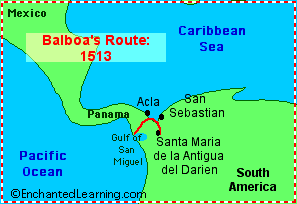
Vasco Nunez: A Man Who Did Not Quite Succeed


There are numerous of influential individuals that are important to reshaping the America that we live in today.  From Christopher Columbus, to Hernan Cortes, those are just some of the few that contributed to the shaping of America. One individual that may not be as well-known but is tremendously important is Vasco Nunez, who may be known as Vasco Nunez De Balboa.


Vasco Nunez was not only an Explorer but he was also a conquistador who helped define the well-known Panama today. He was born around 1475 in Spain. There was once a time when many people in Spain were seeking their fortunes in the New World, and everyone was searching anything that they could get their hands that would increase the riches and wealth. These people were obsessed, as some would think of it as. Nunez was one of the first that joined an expedition to South America. After exploring the coast of present-day Colombia, Nunez stayed on the island of Hispaniola. Today, we all know that as Haiti and the Dominican Republic, according to the map we did for homework, where we had to label regions. But while there, he got into debt and fled, hiding away on a ship headed for the fledgling colony of San Sebastian. Compared to Columbus, Vasco Nunez did not have anyone as generous as King Isabella and King Ferdinand to sponsor his trip with many, or anything that he needed. Eventually, he figured a way out of the problems he was facing.

Once he arrived at the settlement, Nunez discovered that most of the colonists had been killed by nearby native peoples. He then convinced the remaining colonists to move to the western side of the Gulf of Uraba. With not much to lead himself upon, they established the town of Darién on the Isthmus of Panama, which is a small strip land that connects Central America and South America. Today, that land is known as simply Panama, and nothing complicated as the Isthmus of Panama.

Around 1513, Nunez led an expedition from Darién to search the south for gold. Once again, he became one of those influential explorers that had another obsession for Gold, and his own share of it. He hoped that if he was successful he would win the favor of Ferdinand, the king of Spain, even though the Queen and King were not even close to sponsoring his trip. Unfortunately, he did not find any Gold. Although he did not find any Gold, he claimed Pacific Ocean and all of its shores for Spain.


The word quickly spread  that Nunez did not find the "so-called" Gold. That made his weakness of being a failure,highlighted. Immediately as the news followed, the king had sent Pedro Arias de Ávila to serve as the new governor of Darién. The new governor was reportedly jealous of Balboa and ordered him to be arrest on charges of treason.He shouldn't of been jealous because after all he did take the position of Nunez, which was to lead an expedition. Additionally, he was also perceived as a failure because he did not find any Gold, and everyone was obsessed about Gold. After a brief trial, Balboa unfortunately died in 1519.

Saturday, August 18, 2012

Setting the Soil for the Food That Ends Up On Our Table Today


The Planting of English America

1. Colonization in England began in the focusing from the 1500-1733. Great Britain wanted to establish colonies in order to have natural resources for its industries and as market places for the industrial products, which were considered essentially valuable. The government really had few restrictions on who could settle in the American colonies. As long as the colony was profitable, the colonists were pretty much left alone to develop their own colony. This meant that different people could settle in the British colonies without fear of interference with their political beliefs or religious beliefs.

4. In the 2500s, the woolen districts located in England were drastically hit upon hard times economically, and workers lost their jobs. The younger sons often were pressured to migrate the US because the older siblings were the only the only ones that were able to inherit land. It created a wave of change of the percentage of the population that would be rich. The economy of Virginia and other southern colonies heavily relied on slavery. Maryland was considered to be a refugee for Catholics and slaves.  In 1712, North and South Carolina separated officially. This caused conflict when it came to slavery and it automatically made Georgia the buffer colony for runaway slaves.

5. The following are similarities among the Southern colonies of Virginia, Maryland, North Carolina, South Carolina, and Georgia.
-Agriculture was the primary focus of their society

I organized the similarities and differences to make it easier to compare the similarities and differences in the Southern Colonies
Similarities and Differences in Southern Colonies
·         Slavery trade was growing at an alarming because Africans were perceived as capable to overcome diseases.
·         Schools, churches, and even towns, were often stopped from development since Southerners were so spread out.
·         Crops were grown as such:
·         Tobacco - in the Chesapeake region (Virginia, Maryland, North Carolina)
·         Rice and indigo - in the tidewater region of South Carolina and Georgia
·         As a general rule, the plantation South permitted a good deal of religious freedom. Southerners were more interested in making money and growing crops than worrying over church doctrine.
·         White vs. Indian conflicts was frequent.

A New World, A New Beginning


New World Beginnings

1.      History began being recorded an estimate of 6,000 years ago but, the Europeans did not dare to setting foot on land  not until the beginning of 1450, due to a differentiating stage and ambient. Pangaea has geographically structured up to today, our home, planet Earth. The theory behind the well- known Pangaea states that the continents were once nestled together into one mega-continent. As time progressed by, the continents slowly begin to spread out as drifting islands, and created the structure in which they are today, meaning that they have not experienced any movements since Pangaea. All this movement to Earth’s surfaces was the eventful outcome of the Appalachian and Rocky Mountains and the Great Ice Age thrust down over North America and scoured the present day American Midwest. As the Great Ice Age diminished, so did the glaciers over North America.
35,000 years ago, the Land Bridge Theory emerged linking Asia and North America across what is now known as the Bering Sea. People were said to have walked across the "bridge" before the sea level rose and sealed it off; thus populating the Americas.

2.      The Origin and development for the major Indian culture of the Americas started after a while but due to diseases attacking Indians, brought them to their extinction. The development of Indians began with the Incas, Mayas, and the Aztecs. Maize was highly popular and was basically the main product that arrived to the US around 1,200 B.C. Up until the present day, we until use maize or “corn” and in many households has become a well-known food on our dinner tables. The vast majority of people settled down to worked as farmers, and when the right opportunity came by they decided to begin building adobe homes.

3.      After the arrival of surprising of Christopher Columbus in 1492, conflicts and changes begin to erupt when the diverse world of Europe, Africa, and the Americas collided. After 30 dreadful days, he had generally assumed of reaching the East Indies and therefore mistook the people as “Indians.”  In the Americas, the culture was immediately being changed up by the European invading their land. The Indian people of the New World were divided into numerous diverse cultures speaking more than two thousand different languages. Religion wise, the Indians were forced to assimilate to Christianity, forced into slavery on the plantations, and men and women were often conflicted by the matrilinear conflict.