Tuesday, September 25, 2012

My Reflection on The Enlightenment Presentation

     Day One of presentations in AP US History, and I must admit, I got a lot of good information with the first presentation by Fernanda,Astrid, and Stephany. Their presentation was primarily about the Enlightenment period. Before diving into the presentation, they question states, "Using the provided documents,explain how the Enlightenment period influenced the ideas of the American Revolution." Crafting the thesis is becoming a work that keeps going for all of us, and although it is frustrating, it takes time, and eventually we will get there.

Their thesis: "The Enlightenment influenced the American Revolution in three different forms;ideologies,the Declaration of Independence and the Constitution." This is the original thesis, not the thesis that was re-written after we edited as a class. 

Throughout the presentation, we got introduced to the influential individuals during the Enlightenment period. Thomas Hobbes, John Locke, and Jean Jacques Rousseau, were heavily involved during that time period, and still have impacted our society today.
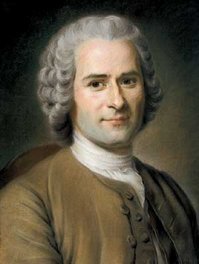
Jean Jacques Rousseau, "The Social Contract"

Jean Jacques Rousseau's political philosophy influenced the French Revolution as well as the overall development of modern political, sociological and educational thought. Additionally, Rousseau introduced "The Social Contract," which elaborates the idea of the idyllic freedom. Basically, in order for someone to get their rights, they would have to sign a form known as "The Social Contract," which gave people their rights. This sounds too good to be true right? Of course, signing "the Social Contract" has its perk-- isolate yourself from society. So much for freedom, after all. I was shocked by what I had learned because I realized that "FREEDOM" was not freedom so much after all. 
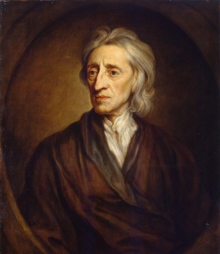

John Locke
John Locke introduced the idea of Natural Rights which he strongly believed in and were Life,Liberty, and the Property. When philosophers were getting together to write the Declaration of Independence, they incorporated Locke's similar beliefs into it. 
"We hold these truths to be self-evident, that all men are created equal, that they are endowed by their Creator with certain unalienable Rights, that among these are Life, Liberty and the pursuit of Happiness." However, instead of keeping the property part, they changed it to the Pursuit of Happiness because maybe "property" was not intended for everyone-- for "WE THE PEOPLE."

Those are the characters we introduced to within the presentation. I tremendously got the "The Social Contract" information cleared up in my head because I was always unsure about what it meant. During our Sophomore year, we had went into the Enlightenment and the complete list of the most influential philosophers but I had forgotten most of it, and this was a great way to get my memory refreshed. I know that for the AP exam, the graders aren't going to be as nice when it comes to the scoring,but this was a great way to learn from mistakes,and to not make them happen once again.


Thursday, September 13, 2012

The First Governor of The Massachusetts Bay Colony


I am English Puritan New World leader  John Winthrop, and was born January 12, 1588 – March 26, 1649) . Throughout my life, I was well known for accomplishing the grueling task of officially joining the Massachusetts Bay Colony in 1629 and was also elected the first governor on April 8, 1630.


When I became governor, I delivered, in an angry tone, my sermon "A city Upon A Hill." It states that the Americas are setting the stage religious wise for others to follow and learn from. God has destined everyone to suffer from the unprecedented events and happenings from Hell.

 Additionally, I was know to be a religious Christian and believed that the Anglican Church had to be cleansed of Catholic ritual.English Puritans needed a shelter away from England where they could remain safe during the time of God’s wrath, and I was going to help them find a relief towards the Catholic ritual.I declared that the Puritan colonists emigrating to the New World were part of a special pact with God to create a holy community. They were going to be influential for generations
 to come.

During my term for being the Governor, I was one of the least radical of the Puritans. People liked me because  the number of executions were being maintained at a minimum and was working towards preventing the implementation of more conservative practices such as veiling women.


In total I married 4 times, and had a total of 13 children.

·         Mary Forth, was my first wife, and we married on April 16, 1605 at Great Stambridge, Essex, England. She bore him six children and died in June 1615. The youngest son became the Governor of Connecticut in a later stage of life.
·         Thomasine Clopton, was my second wife. We got married  on December 6, 1615, at Groton, Suffolk, England. Unfortunately, the love of my life at the time died on December 8, 1616. We did not have any children.
·         I married  Margaret Tyndal, my third wife on April 29,1968. I had the most children with Margaret Tyndall , as together we engendered  six children in England before the family emigrated to New England .Many people don’t know this but, one of my daughters died on the Lyon voyage. Two children were born to them in New England in 1630. Margaret died on June 14, 1647.
·         Finally, I married Martha Rainsborough, who was a widow of Thomas Coytmore. In this marriage however, we did not have more than one son and that was in 1648.


I  signed the Cambridge Agreement March 4, 1629,to embark on the next voyage and find a new Puritan colony in New England. The colony’s land was taken from Native Americans with Winthrop’s excuse that the natives hadn’t “subdued” the land and thus had no “civil right” to it.


I was the governor of the Massachusetts Bay Colony in 1629 and served for a total of 19 years years. The Constitution operated differently to the way it does today, because today the presidents are allowed to serve for only two terms, a total of 8 years.