Rosa Parks was born in Tuskegee, Alabama, on February 4, 1913, to Leona and James McCauley, a teacher and a carpenter
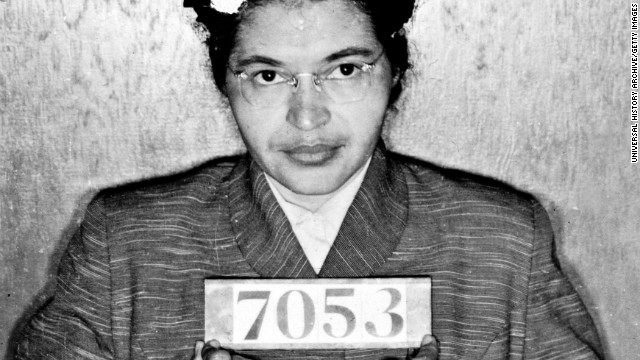
Rosa Parks was perceived as hard-working ans quiet. But on December 1, 1955, in Montgomery, Alabama, Parks refused to obey bus driver, NOT ONCE, BUT THREE TIMES! James F. Blake's order that she give up her seat in the colored section to a white passenger, after the white section was filled. Parks was not the first person to resist bus segregation. But she was certainly the last one to remain seated when everyone the other two people gave in to their resistance. Others had taken similar steps in the twentieth century, including Irene Morgan in 1946, Sarah Louise Keys in 1955, and Claudette Colvin nine months before Parks. NAACP organizers believed that Parks was the best candidate for seeing through a court challenge after her arrest for civil disobedience. But overall, she exemplifies that it is possible to show resistance in a non-violent way, without the use of weapons or any other methods.
Parks received national recognition, including the NAACP's 1979 Spingarn Medal, the
Presidential Medal of Freedom, the Congressional Gold Medal , and a posthumous statue in the United States Capitol's National Statuary Hall. Upon her death in 2005, she was the first woman and second non-U.S. government official to lie in honor at the Capitol Rotunda.Parks received national recognition, including the NAACP's 1979 Spingarn Medal, the
APPARTS on Rosa Parks
Arrest Report on Rosa Parks
Author: City Of Montgomery
Place/Time: December 1,1955 in Montgomery Alabama
Prior Knowledge: She worked as the secretary for the NAACP (National Association for the Advancement of Colored People) for a many years.
Audience: Everyone
Reason: On December 1, 1955, Rosa Parks was arrested for refusing to give up her seat to a white passenger on a city bus in Montgomery, Alabama.
Main Idea: Rosa Parks is a great example of non-violent resistance.
Significance: This single act of non-violent resistance sparked the Montgomery bus boycott, an eleven-month struggle to desegregate the city buses. Under the leadership of Martin Luther King Jr., the boycott resulted in a U.S. Supreme Court ruling that public bus segregation is unconstitutional and catapulted both King and Parks into national spotlight.

